Russia’s history myths unmasked

Source: Draft Agreements between the USA/NATO and Russia on Security Guarantees 22 December 2021
Objective: Stabilisation of Russia’s sphere of influence in Central and Eastern Europe, discrediting domestic opposition
In the last weeks of 2021, two months before Russia’s full-scale invasion of Ukraine, the Russian foreign ministry published a draft NATO-Russia agreement on “security guarantees”. The draft treaty would have required NATO to refrain not only from any further eastward expansion but also from any form of military activity in Ukraine, in Central Asia or anywhere in Eastern Europe. In addition, the old NATO member states – the US, the UK, France, Germany, et al. – would have had to withdraw all their troops from Eastern Europe, particularly those in Poland and the Baltic countries.
Though never signed, the draft agreement is seen to this day as an articulation of the “maximum programme” of Russian foreign policy. But why does Russia feel a need for “security guarantees” from the West at all?
The political-historical narrative underpinning Russia’s security fears is described in an article published shortly before Russia launched its attack on Ukraine by the journalist and foreign policy expert Alexander Baunov.
From the Kremlin’s perspective, in Baunov’s description, Russia has met with attacks from Europe three times in the last two centuries “by countries that were wealthier and had a higher standard of everyday culture and more developed social institutions”. During World War II, European soldiers fought Russia, its army and its civilian population, soldiers from Germany but also from countries like the Netherlands, Denmark or Italy – countries that now see themselves as harmless, as posing no danger. And this, although no “dangerous Russian soldier” had set foot on their territories for centuries.
Through the lens of this narrative, Russia sees good historical reasons to demand that NATO keep as far away from Russia’s borders as possible. It is merely asking for its own historical fears to receive the same consideration given to those of its neighbouring countries.
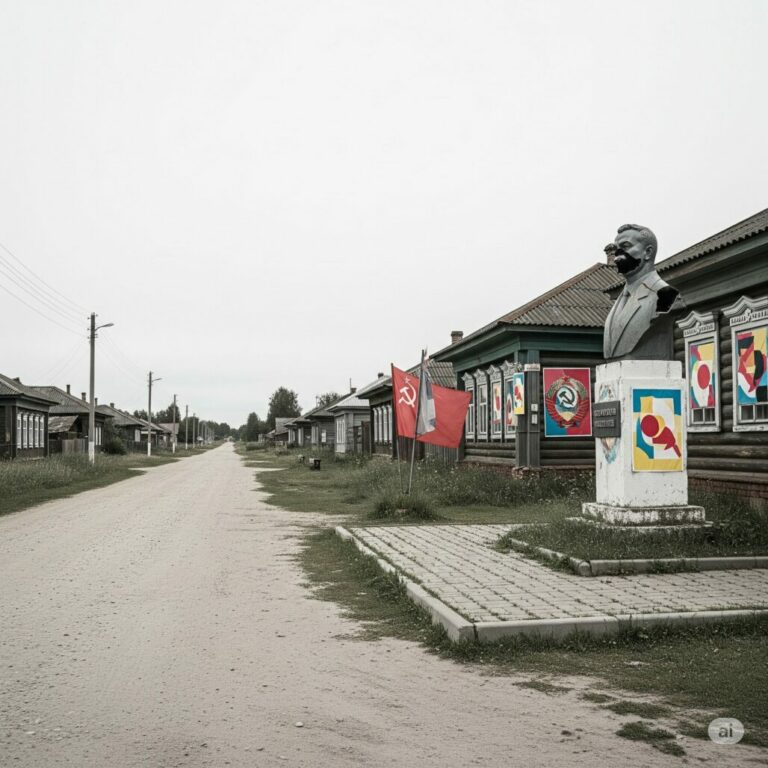
AI note: dekoder used Google Gemini to create this illustration
The West as the enemy of Russia: where did this narrative originate?
Hostility towards the West and towards Europe, in particular, has very deep roots in Russia, which reach back to the Middle Ages and are bound up with religious convictions. The origins of the debates shaping Russian public opinion more recently, though, lie in the 19th century. Back then, the dispute was primarily one of domestic policy, with the “zapadniki” [Westernizers – dek.] and the “Slavophiles” clashing over whether European-oriented reforms benefited or harmed Russia. However, another aspect was already making an appearance as well: that the neighbouring countries or peoples might constitute an existential threat for Russia.
Poland was a particular focus of “suspicion” in this respect. The Polish-Lithuanian Commonwealth had been divided up by Russia, Prussia and Austria in the late 18th century. One of the justifications put forward for this obvious instance of colonial expansion was historical: Polish troops had occupied Moscow in the early 17th century. The conservative Russian journalist Mikhail Katkov wrote a contemporary article on the January Uprising of 1863/64 that might have been penned today in a similar tone by a Russian propagandist about the ongoing war against Ukraine. For instance, Katkov wrote that Russia and Poland could not exist alongside one another as two independent states and that the Commonwealth had been an “artificial state”. The Kremlin presents Ukraine in its wartime propaganda in just the same way.
The January Uprising broke out just seven years after Russia’s ignominious defeat in the Crimean War by a broad coalition of European countries. The memories of that defeat, still fresh, strengthened anti-European sentiment and fuelled conspiracy theories. Even the antisemitism that was spreading throughout Europe at the time had a strikingly anti-Western cast in Tsarist Russia.
After the Russian Revolution of 1917 and especially after World War II, this hostility towards the West acquired an additional, ideological dimension: the Eastern Bloc took shape as a cordon sanitaire, a sort of buffer zone between Western Europe and the Soviet Union of the kind that the Kremlin still desires today as a “security guarantee”.
How is history being (mis)used here?
The origin of Putin’s hostility towards the West is open to debate: whether it springs directly from this old intellectual tradition or has more to do with more recent developments and the resentment of the West among Russia’s ruling elites after the collapse of the Soviet Union. Regardless though, the narrative of the West as Russia’s enemy shapes both Russia’s foreign policy ambitions and the domestic policy goals of the Russian ruling elite.
In the foreign policy domain, the war of aggression against Ukraine is the most blatant example of this. In domestic policy, it is most obvious in the discriminatory and repressive action taken against the Russian opposition, independent media and NGOs. The justification offered for these measures is that their targets represent the interests of foreign adversaries. One cannot help but be reminded here that Katkov also wrote of a “secret international organisation” that lay behind all revolutions (though he, unlike many of his conservative contemporaries, did not believe that foreign states had initiated the January Uprising).
The “security guarantees” that the Kremlin has since been demanding for Russia are merely a synonym for the sphere of influence that Moscow wants to bring under its control with the help of historical arguments. This is evident in the fact that while Russia’s 2021 draft for an agreement with NATO makes numerous demands of the Western states, it places practically no obligations on Russia.
What historical realities does Russia’s narrative obscure?
This narrative of so-called “history” is not merely historically inaccurate but, quite simply, false. Numerous Central and Eastern European countries have been the victims of numerous acts of military aggression from the West and also specifically from Russia. This alone contradicts the Kremlin’s argumentation with regard to the exceptional nature of the historical circumstances of present-day Russia.
In fact, the only armed conflict in which Russia fought alone against an alliance of major Western powers was, arguably, the Crimean War (in which Austria and Prussia remained largely neutral). In earlier and later wars, Russia was always part of a coalition including multiple Western countries. Napoleon’s France, for instance, was the enemy of both Russia and England; in both world wars, the Russian Empire / the Soviet Union was allied with Western countries in the fight against Germany. This is yet more evidence that the “collective West” (term used in present-day Russian propaganda demonising Western countries) never existed in reality.
This contradiction has not escaped the present-day propaganda and policy makers in Russia, as evidenced by numerous conspiracy theories that have been making the rounds in recent years. These claim to explain, for instance, why the Soviet Union joined with Britain, the US and France to form the anti-Hitler coalition, a circumstance that does not fit in well with the idea of the “eternal, collective West vs. Russia”. On 9 May 2024, i.e. Victory Day in Russia, a Russian government website published a pseudo-scholarly article by Dmitry Medvedev explaining that Hitler’s seizure of power had originally been financed by the “Anglo-Saxons” (meaning the UK and the US). This brings the concept of the “collective West” back into play.
The Clash of Civilizations and the Remaking of the World Order by the US political scientist Samuel Huntington and Zbigniev Brzeziński’s The Grand Chessboard: American Primacy and Its Geostrategic Imperatives were bestsellers in Russia after the Cold War. Both books deal with international relations as the confrontation between “eternal” geopolitical entities. These ideas are also very popular in Russian scholarship. The quote “[w]ithout Ukraine, Russia ceases to be a Eurasian empire” (thus becoming solely Asian), which has been repeated more than once in Russia’s “patriotic” and neo-imperialist circles, comes from that book by Brzeziński.
Neither of those American authors had much interest in the question of the extent to which a country’s relations with other countries were influenced by its own domestic developments. This factor is also being disregarded today by the Russian ruling elite: specifically, the major role that a country’s internal dynamics play in determining how it is perceived from abroad.
It is important to recognize that much of what Russian society perceives as hostility towards Russia in the views or actions of states or people in the West (or in the version thereof presented by the Russian propaganda machine) is nothing other than a reaction to political developments in Russia. This includes the country’s aggressive refusal to examine and acknowledge its own colonial past – which tends to trigger a reaction in Russia’s neighbouring countries, most of which are very sensitive in this regard.
Even before the annexation of Crimea in 2014, efforts were underway within many of the governments and civil societies of Central and Eastern Europe to secure guarantees against potential attacks by Russia. For good reasons, not all of which are historical.
We are publishing this piece in cooperation with the German section of the Deutsch-Russische Geschichtskommission (Joint Commission for Research into the Recent History of German-Russian Relations) and BKGE (Federal Institute for History and Culture of the Germans in Eastern Europe, Oldenburg).